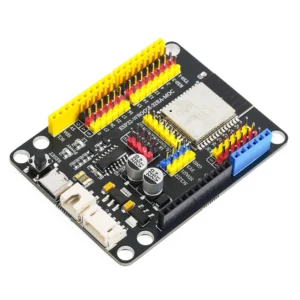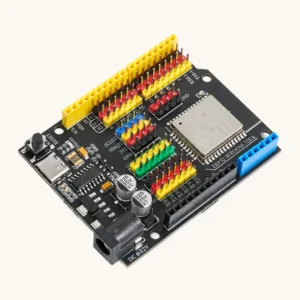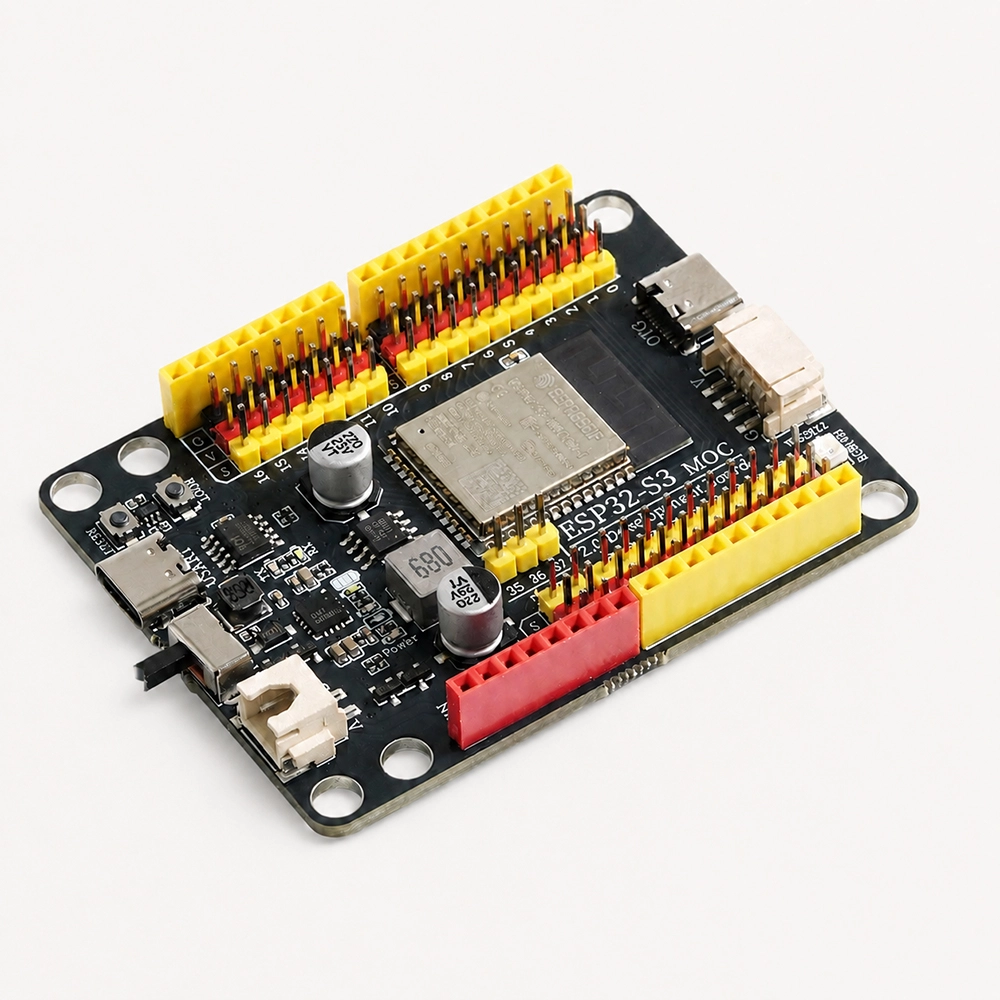
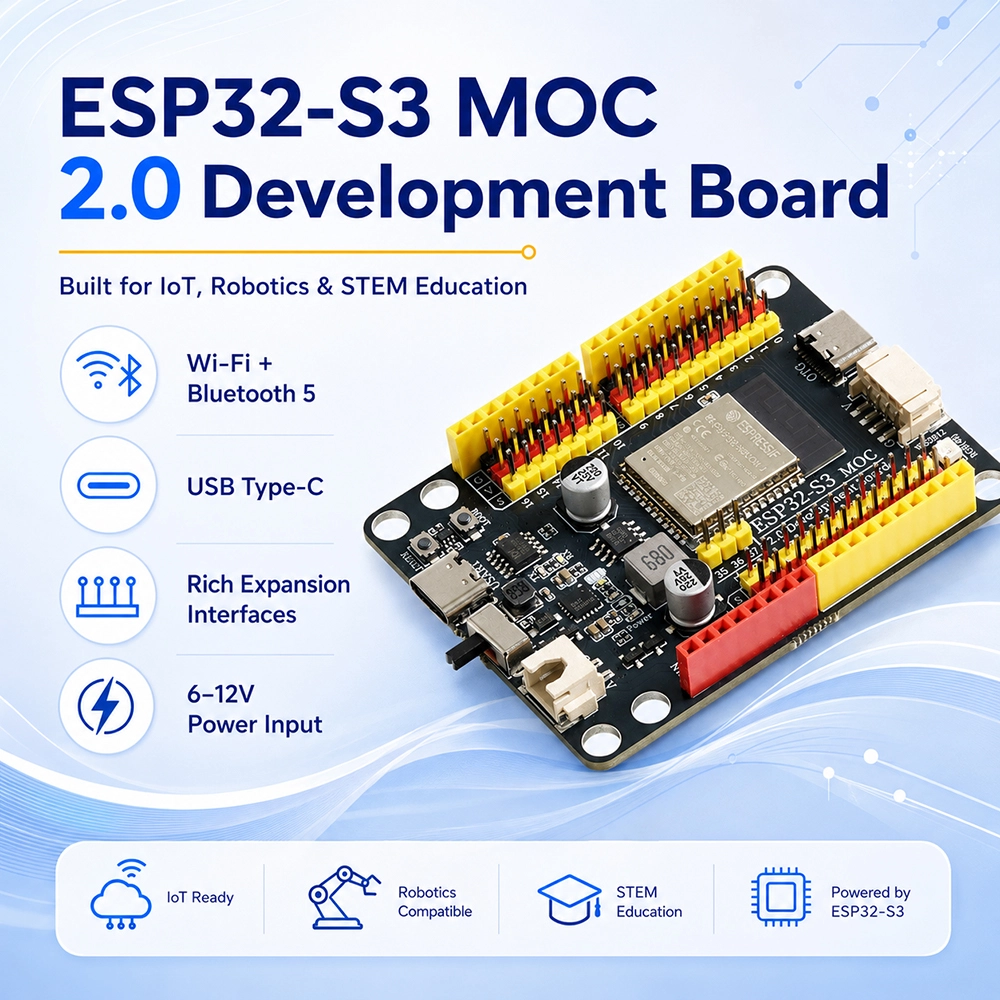
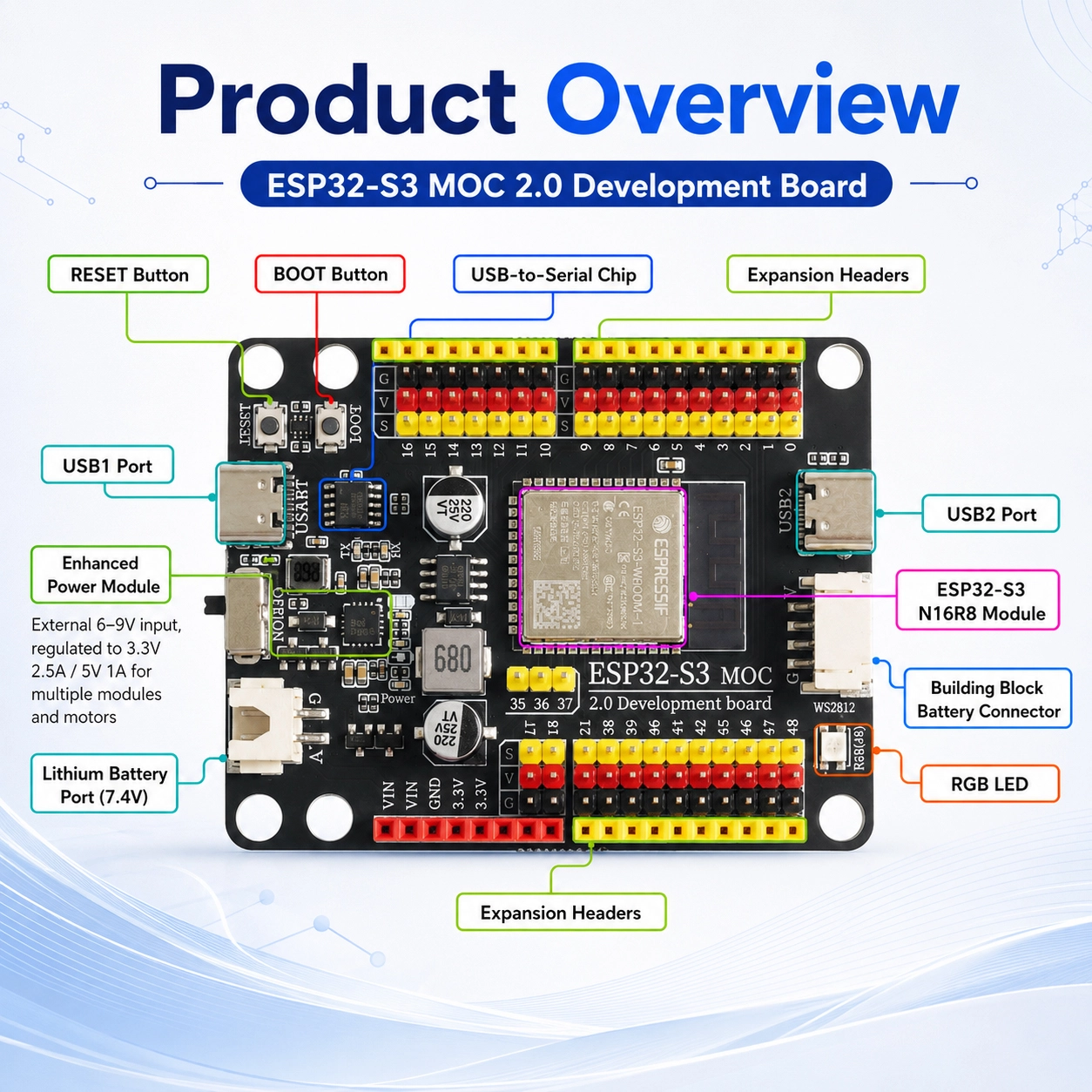
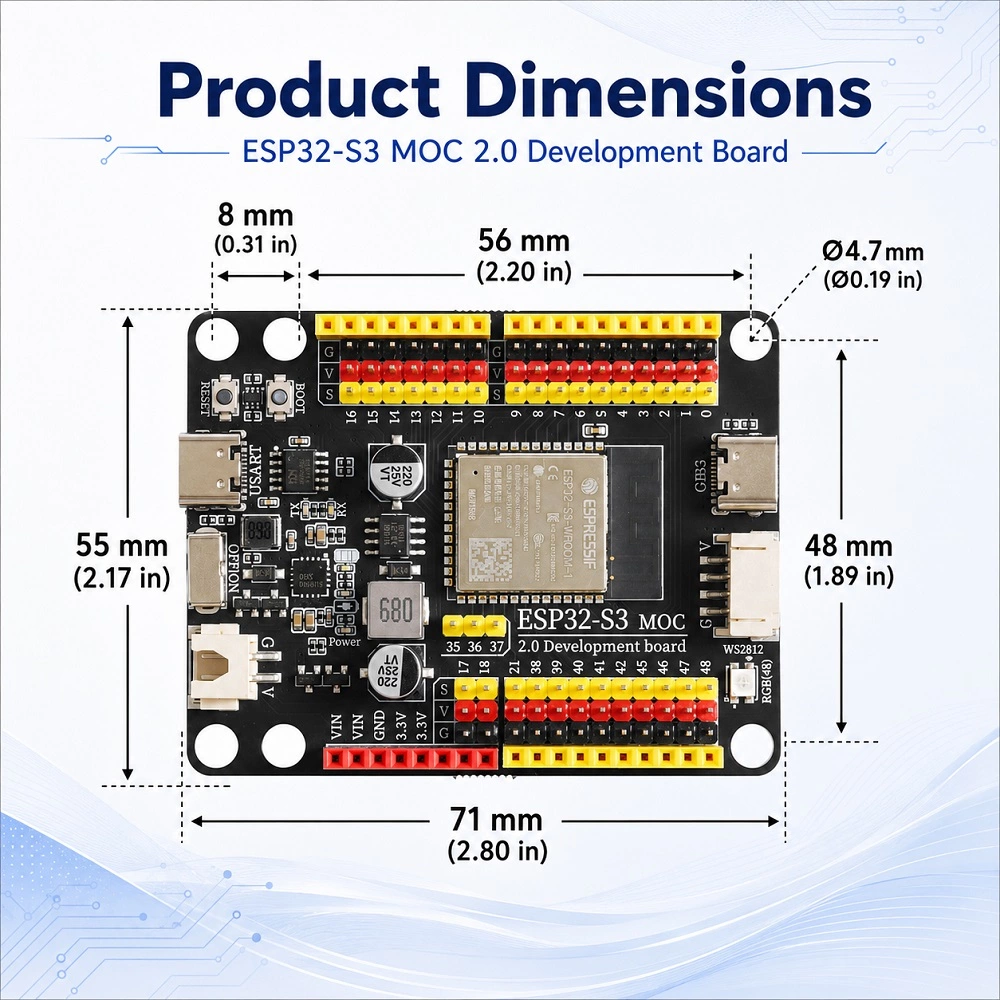
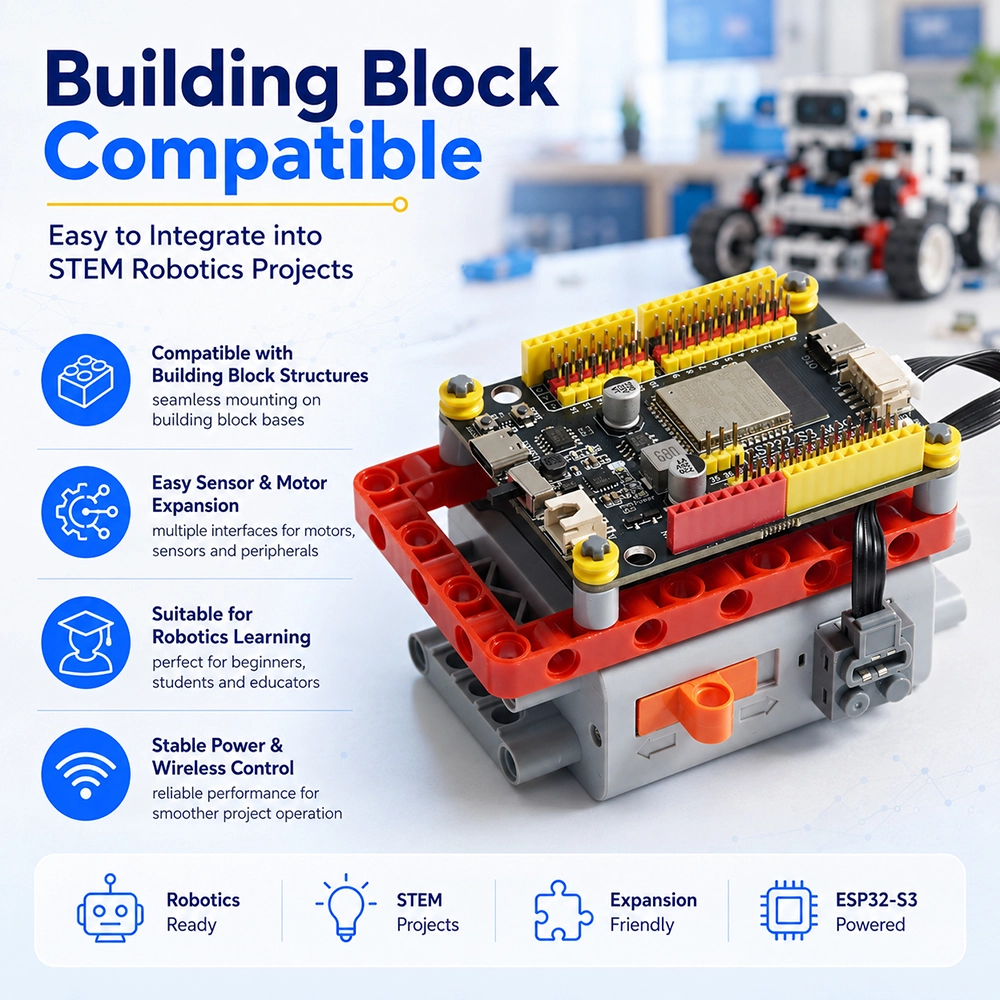
The ESP32-S3 MOC is not just a development board; it is a high-performance Edge AI gateway designed specifically for the global education market. Built on the latest Xtensa® 32-bit LX7 Dual-Core architecture, it provides the raw computing power needed for local voice recognition, simple computer vision, and complex neural network experiments—without needing a constant cloud connection.
Technical Specifications
| Parameter | Specification |
|---|---|
| Microcontroller | ESP32-S3-WROOM-1-N16R8 |
| Operating Voltage | 3.3V |
| Input Voltage | 6-12V (DC) |
| Digital I/O Pins | 29 |
| Analog Input Pins | 18 |
| Programming Interface | USB Type-C |
| Wi-Fi Connectivity | 2.4 GHz Wi-Fi (802.11b/g/n) |
| Bluetooth Standard | Bluetooth 5 (LE) Module |
| Clock Frequency | 240 MHz |
| External Flash | 16 MB |
| SRAM | 512 KB |
| RTC SRAM | 16 KB |
| Internal ROM | 384 KB |
Projects You Can Build
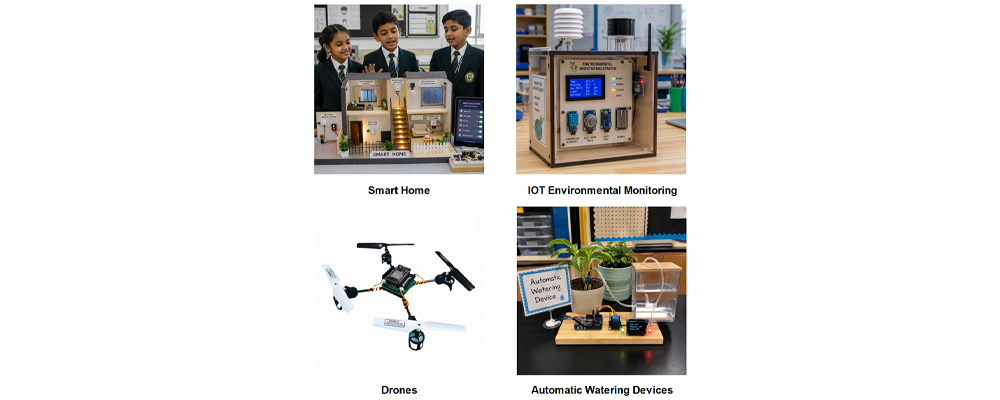
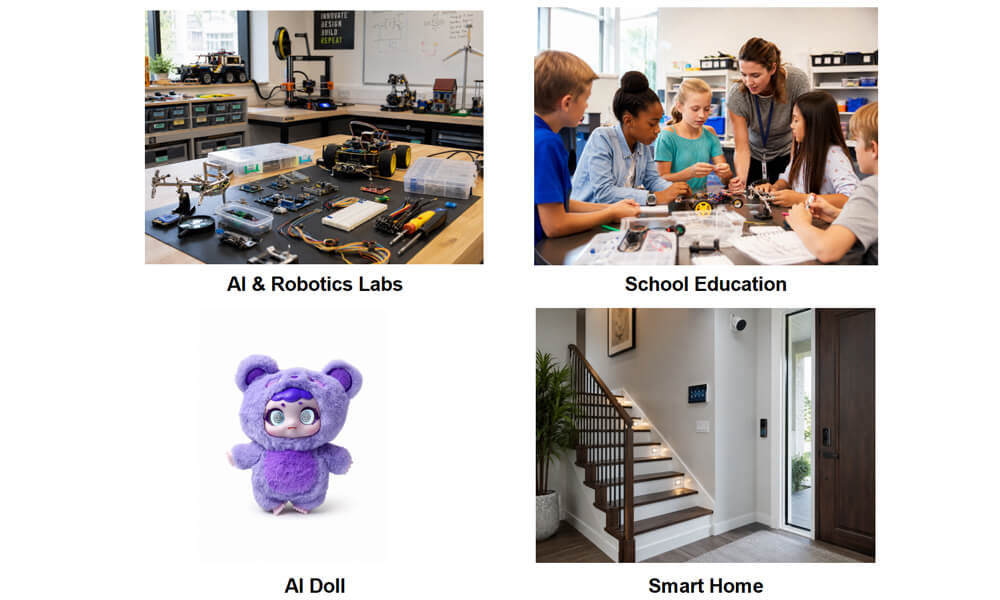
Build smart home systems, environmental monitoring stations, Bluetooth-controlled robots, automatic watering devices, RGB lighting projects, and other IoT or STEM robotics applications with this ESP32-S3 development board.
Application Scenarios
- Maker Projects: Robots, smart devices, automatic watering systems, and DIY electronics projects.
- STEM Education: Hands-on programming, sensor experiments, robotics, and IoT learning kits.
- AI Products: Voice recognition, gesture recognition, sound classification, and edge AI devices.
- Smart Home Control: Lighting control, security alarms, smart windows, voice-controlled curtains, and Bluetooth app control.
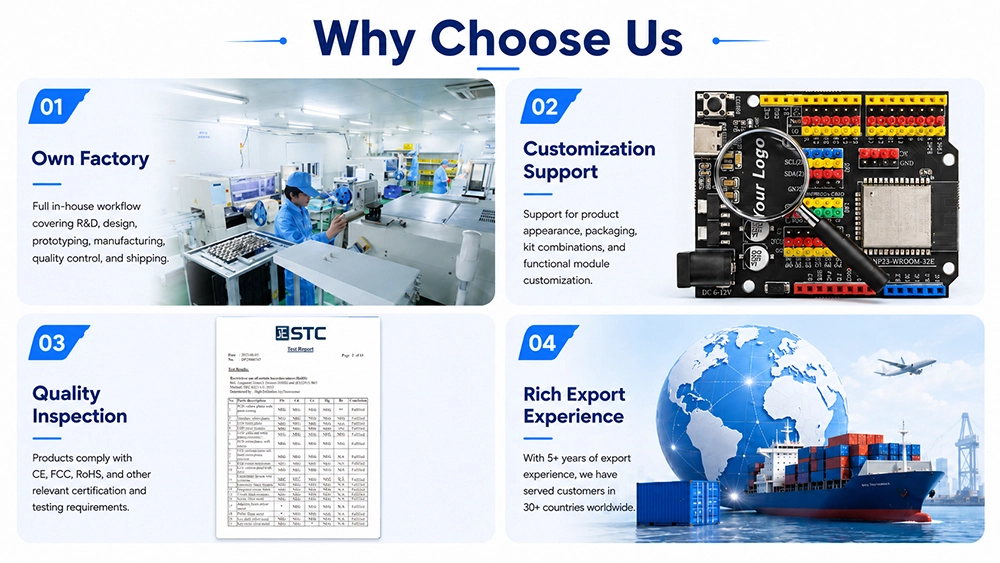
Why Choose Us
We provide in-house design, manufacturing, strict quality control, and global export experience to provide reliable, customizable, and high-quality STEM development products.
FAQ
1. Q: What is the ESP32-S3 development board used for?
A: ESP32-S3 is widely used for IoT projects, smart home control, robotics, AI applications, voice recognition, sensor monitoring, and STEM education.
2. Q: Does ESP32-S3 support Wi-Fi and Bluetooth?
A: Yes. ESP32-S3 supports 2.4GHz Wi-Fi and Bluetooth LE, making it suitable for wireless IoT applications.
3. Q: Can ESP32-S3 be used for AI projects?
A: Yes. ESP32-S3 supports edge AI applications such as voice recognition, gesture recognition, sound classification, and simple image recognition.
4. Q: Is ESP32-S3 suitable for beginners?
A: Yes. It is suitable for beginners, students, makers, and engineers. It can be programmed with Arduino IDE, ESP-IDF, MicroPython, and other tools.
5. Q: What projects can students build with ESP32-S3?
A: Students can build smart home systems, automatic watering devices, environmental monitoring stations, robots, voice-controlled devices, and Bluetooth app control projects.
6. Q: Can ESP32-S3 control motors and servos?
A: Yes. ESP32-S3 can control DC motors, servo motors, robot arms, smart cars, fans, curtains, and other motion-control devices.
7. Q: Can ESP32-S3 connect to sensors?
A: Yes. It can connect to temperature sensors, humidity sensors, light sensors, motion sensors, gas sensors, rain sensors, soil moisture sensors, and more.
8. Q: Is ESP32-S3 good for smart home projects?
A: Yes. It can be used for lighting control, door sensors, security alarms, smart windows, voice-controlled curtains, gas alarms, and mobile app control.
9. Q: What is the difference between ESP32 and ESP32-S3?
A: ESP32-S3 offers stronger AI processing capability, better USB support, Bluetooth LE, and improved performance for A IoT and edge AI applications.
10. Q: Does ESP32-S3 support camera modules?
A: Yes. ESP32-S3 can work with compatible camera modules for image capture, object recognition, face detection, and visual AI projects.