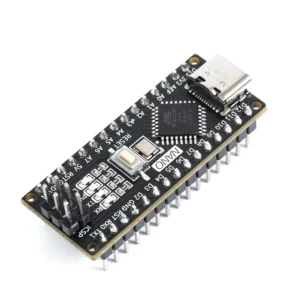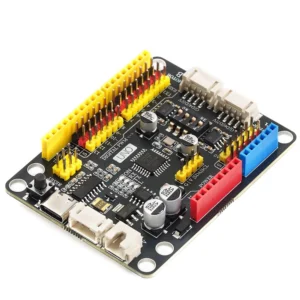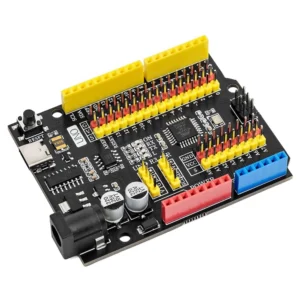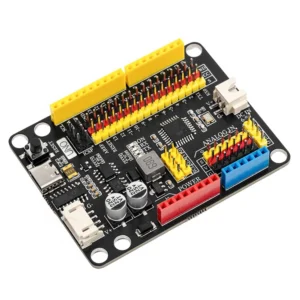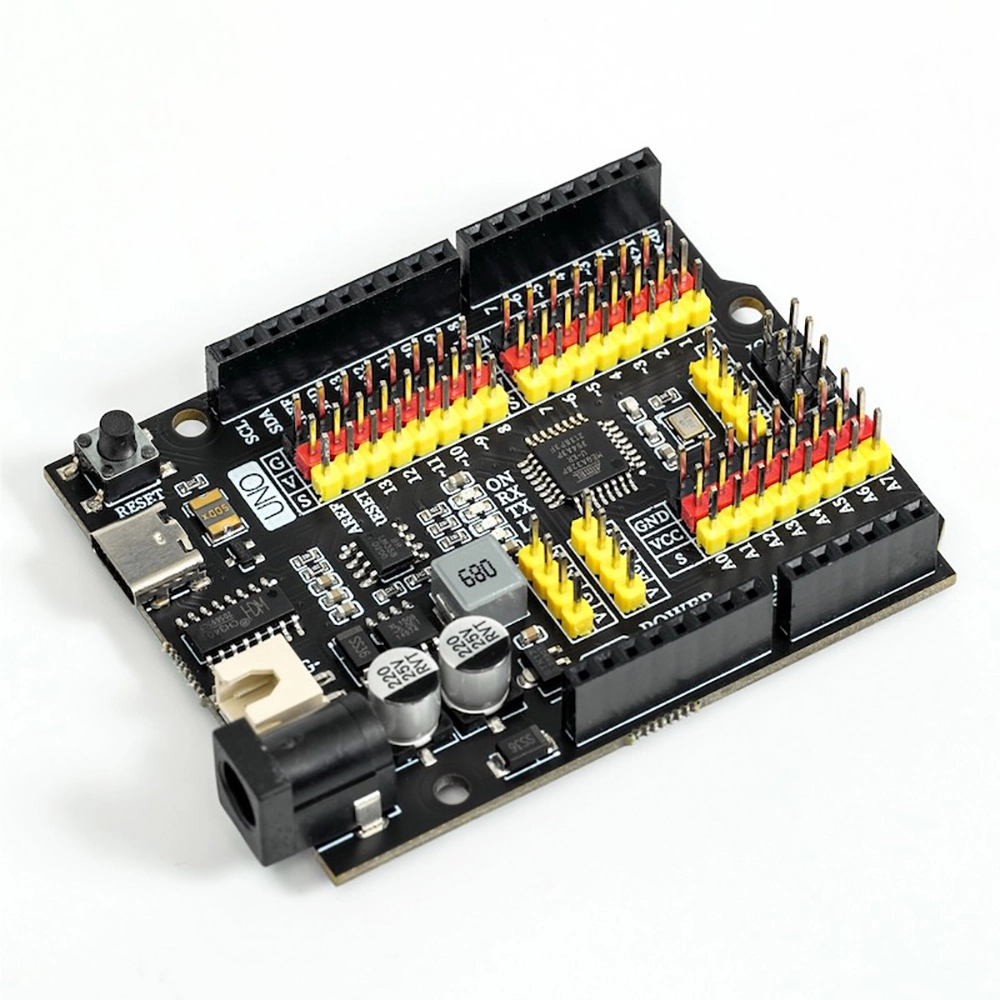
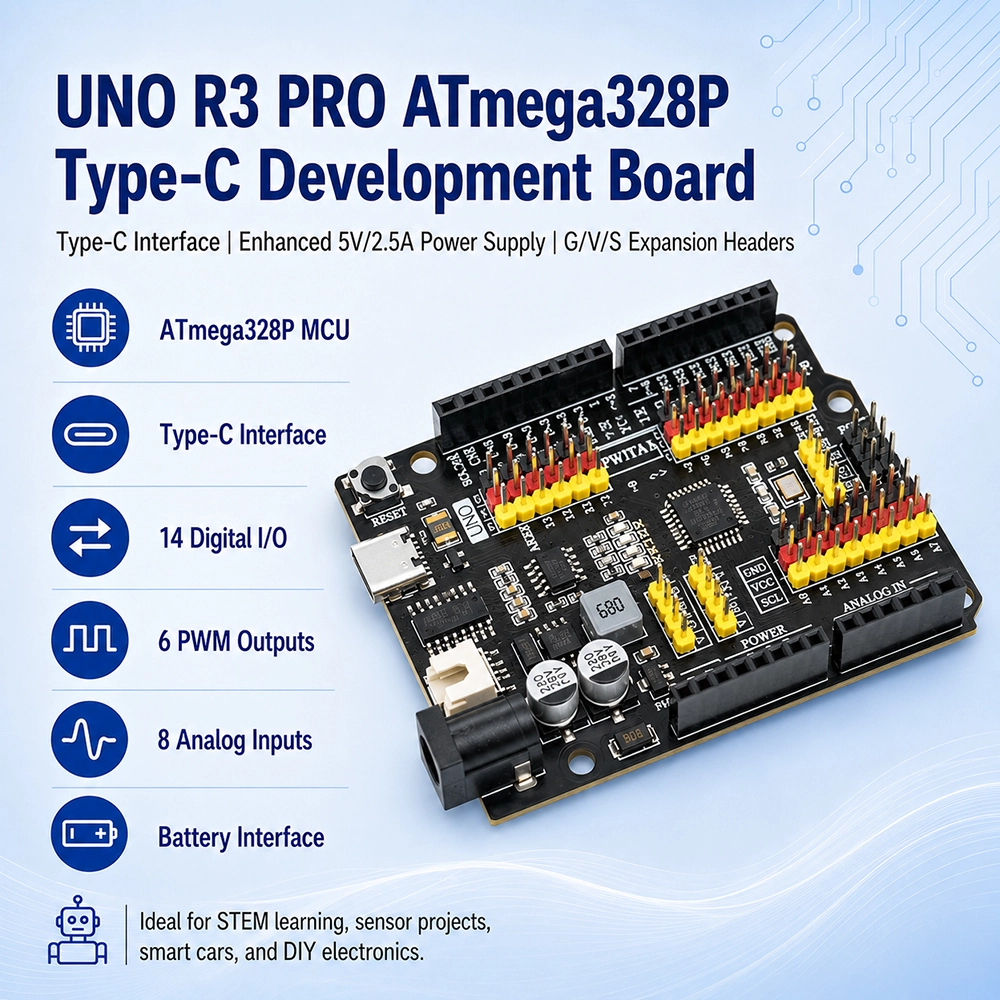
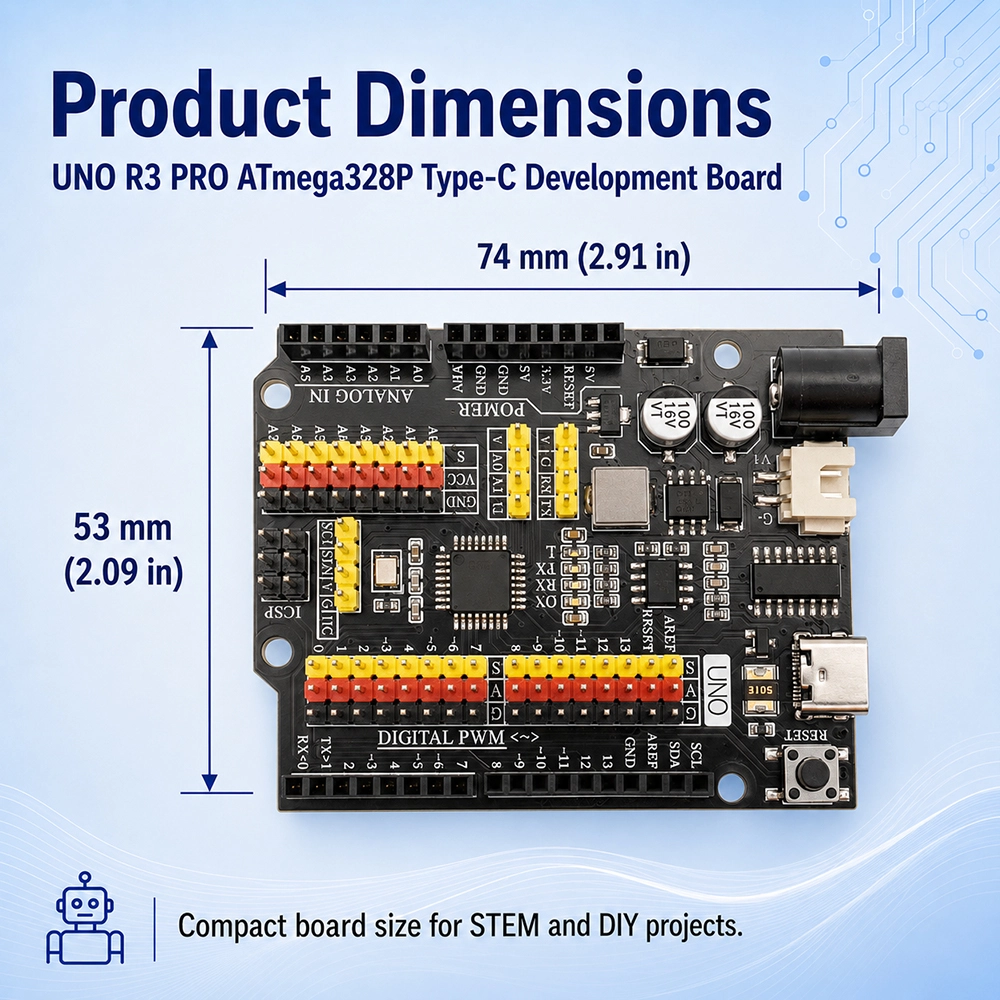
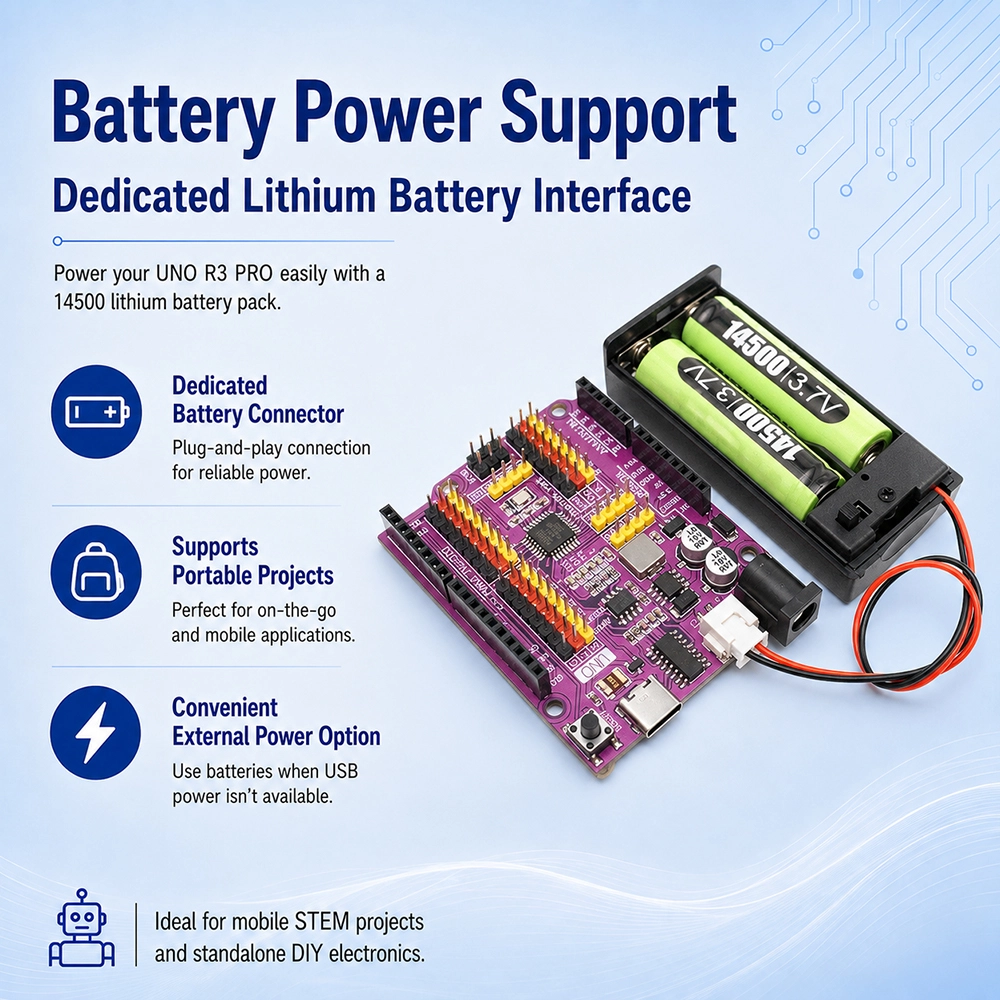
The UNO R3 PRO upgrades to a robust USB Type-C port and integrates a high-efficiency 5V/2.5A (12.5W) power module. This massive power headroom allows users to drive multiple high-torque servos, toy motors, and advanced micro-slides directly without an external shield. Additionally, it features an on-board dedicated lithium battery port (supporting 14500/18650 batteries), which is good choice for untethered mobile robots, advanced STEM education, and complex IoT prototyping.
Technical Specifications
| Parameter | Specification |
| Product Name | UNO R3 PRO ATmega328P Type-C Development Board |
| Microcontroller | ATmega328P-PU |
| Compatibility | Compatible with Arduino UNO Rev3-style projects |
| Operating Voltage | 5V |
| Recommended Input Voltage | 7–12V DC |
| Digital I/O Pins | 14 |
| PWM Digital I/O Pins | 6 |
| PWM Pins | D3, D5, D6, D9, D10, D11 |
| Analog Input Pins | 8 |
| Analog Pins | A0–A7 |
| DC Current per I/O Pin | 20mA |
| 5V DC Power Output | 2500mA |
| Flash Memory | 32KB |
| Bootloader Memory Usage | 0.5KB |
| SRAM | 2KB |
| EEPROM | 1KB |
| Clock Frequency | 16MHz |
| Clock Source | 16MHz crystal oscillator |
| USB Interface | USB Type-C |
| Power Input Interfaces | USB Type-C, DC power jack, lithium battery interface |
| ICSP Header | Yes |
| Reset Button | Yes |
| Onboard LED | D13 |
| Expansion Headers | G/V/S sensor and actuator headers |
| Additional Analog Expansion | A6 and A7 |
| Dedicated Module Ports | 3 groups |
| USB Protection | Resettable fuse protection |
| Programming Interface | USB Type-C / ICSP header |
| Suitable Battery Interface | Dedicated lithium battery interface |
Projects You Can Build
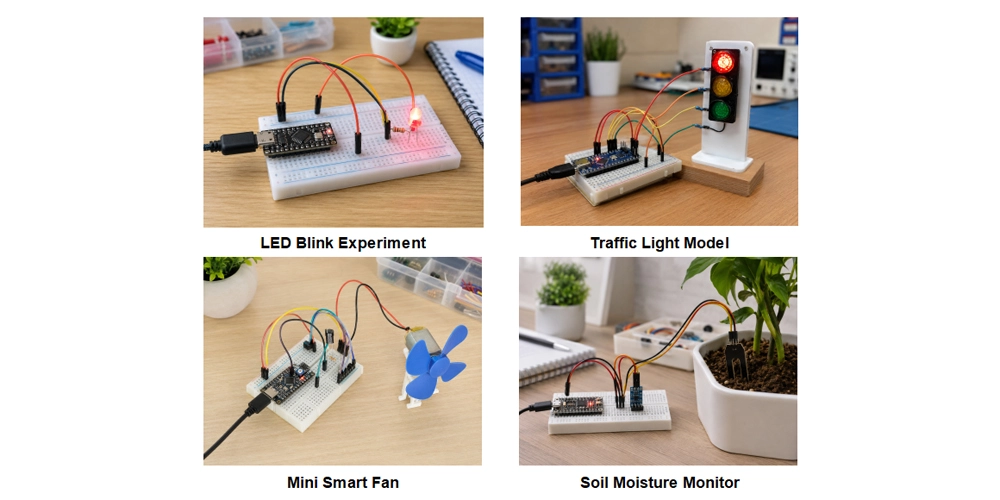
The UNO R3 PRO can be used for a variety of beginner-friendly electronics and programming projects. Users can create LED blink experiments, traffic light models, PWM LED dimming projects, sensor data collection systems, servo control projects, smart car models, simple alarm systems and smart home demonstrations. With 14 digital I/O pins, 6 PWM outputs, 8 analog inputs and G/V/S expansion headers, it is ideal for STEM learning, robotics practice and DIY electronics projects.
Why Choose Us
We understand that different markets and educational systems have different teaching requirements. That is why our customization service goes far beyond simple logo printing. We provide comprehensive ODM solutions, including product appearance customization, packaging design, curriculum adaptation, sensor/module configuration, and even hardware architecture modification. From concept to production, we help customers create tailored STEM education products that better match local classrooms, learning goals, and brand needs.

FAQ
Q1: Is this board 100% software compatible with the official Arduino UNO Rev3?
A: Yes, absolutely. The board is built on the ATmega328P-PU microcontroller and a 16MHz crystal oscillator. In the Arduino IDE, Mixly, or Scratch, you simply select “Arduino Uno” as the board type. It works out-of-the-box with all official libraries and existing sketches without any code modification.
Q2: Why does this board offer a 5V/2A (10W) power module while standard boards only offer 500mA?
A: Standard UNO boards draw power from a computer’s USB port, which is capped at 500mA. This is often insufficient for robotics.
Data Support: Driving just two SG90 servos can cause current spikes that trigger a “Brownout Reset” on standard boards.
The PRO Advantage: Our integrated 2A buck converter allows you to drive 4 to 6 mini servos or small DC motors directly from the G|V rail, eliminating the need for expensive, bulky external motor shields.
Q3: What are the benefits of the USB Type-C interface? Does it support C-to-C cables?
A: Durability: Type-C ports have a higher insertion rating and are reversible, significantly reducing mechanical damage in classroom settings.
Data Support: The board utilizes the CH340C serial chip. Unlike older “CH340G” versions, our design is optimized for Type-C to Type-C cables used by modern MacBooks and high-end laptops, ensuring stable data transmission and power delivery.
Q4: What is the “G|V|S” header design and why is it called “Shield-Free”?
A: GVS stands for Ground, Voltage, and Signal. Efficiency Data: In traditional STEM setups, wiring sensors on a breadboard leads to a 20-30% error rate due to loose jumper wires.
The Solution: By arranging the 14 digital and 8 analog pins in a 3-pin GVS sequence, students can use standard 3-pin anti-reverse cables to plug sensors directly into the board. This creates a much more compact, reliable project with zero need for a separate “Sensor Shield.”
Q5: Can the extra A6 and A7 analog pins be used like standard A0-A5 pins?
A: Partially. Technical Limit: According to the ATmega328P datasheet, A6 and A7 are dedicated analog inputs.
Functionality: While they are perfect for reading potentiometers, thermistors, or light sensors, they cannot be configured as “Digital Outputs” (e.g., you cannot use digitalWrite to turn on an LED on A6 or A7).
Q6: Can I use the on-board Lithium battery interface to charge my battery?
A: No. The dedicated battery port is for power input only. Circuit Logic: It connects directly to the board’s high-efficiency DC-DC regulator. You can plug in a 3.7V or 7.4V lithium pack to power your mobile robot wirelessly. However, there is no on-board charging management; you must use an external charger to recharge your batteries.
Q7: How does the board protect my computer’s USB port from damage?
A: We have integrated a 500mA PTC Resettable Fuse. Protection Logic: If a student accidentally creates a short circuit (e.g., connecting VCC to GND), the fuse will sense the overcurrent and “trip” in milliseconds to disconnect the power. Once the short is removed and the fuse cools down, it automatically resets—protecting your laptop from a permanent hardware failure.
Q8: What happens if I plug in both the DC Barrel Jack and the USB cable?
A: The board features an Automatic Power-Switching Circuit (comprised of an FDN340P MOSFET and LMV358 Op-Amp). Priority Logic: It intelligently detects the higher voltage source. If an external power supply (6-12V) is connected, it automatically shuts off the USB power path to prevent back-feeding current into your computer while providing the full 2A current needed for heavy motor loads.